
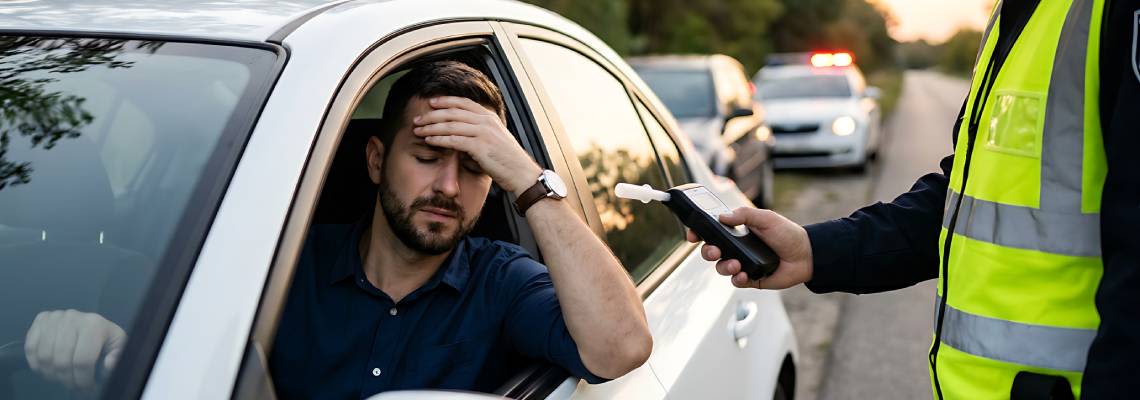
The Problem with Rising Blood Alcohol: Proving You Were Under the .08 Limit While Driving on Texas Roads
Maybe your breath test read 0.09, but it was taken more than an hour after the officer first pulled you over. That gap matters. Texas law asks whether you were intoxicated while driving, not while blowing into a machine at the station, and blood alcohol can keep climbing for a while after your last drink.
The catch is that Texas courts still let jurors weigh a later test, and prosecutors can try to prove impairment without relying on the number at all. You must build a rising blood alcohol argument with evidence, not simply assert it.
At The Law Office of Justin K. Hall P.C., I defend drivers in Rockwall and throughout Dallas, Collin, Hunt, and Kaufman counties whose cases turn on what a test result can and cannot prove about the moment they were behind the wheel. If your arrest involved a delayed breath or blood test, the timeline deserves a close look before you decide how to answer the charge, and you can start that review with a free consultation.
What Is Rising Blood Alcohol?
Rising blood alcohol describes the absorption phase, the stretch of time after drinking when alcohol is still moving from your stomach and small intestine into your bloodstream. During that window, your blood alcohol concentration (BAC) goes up even though you have stopped drinking. Only after absorption winds down does your body begin bringing the level back down.
Absorption time varies from person to person and night to night. What you drank, how fast you drank it, whether you had eaten, and your body size all play a role. That variability is the heart of the problem. If you finished a drink shortly before getting in the car, a reading taken an hour or more later may capture a level you hadn't reached while you were driving.
Why Test Timing Matters Under Texas Law
In a Texas DWI case, the legal question is your condition while you were operating a vehicle in a public place, not your condition at the jail. The Texas Penal Code's intoxication chapter defines "intoxicated" in two ways: having an alcohol concentration of 0.08 or more, or not having the normal use of your mental or physical faculties because of alcohol or another substance. Section 49.04 then makes it an offense to be intoxicated while operating a motor vehicle in a public place.
No test measures you at the wheel. Breath and blood samples come later, after the stop, the field sobriety tests, the arrest, the drive to the station, and sometimes a wait for a blood-draw warrant.
Each step widens the distance between the number the State has and the number the law actually cares about. When that distance is large and your drinking was recent, a result slightly over 0.08 may say more about the test's timing than about your driving.
Can a Delayed Test Still Be Used Against You?
Yes. Texas's highest criminal court has held that a breath or blood result taken a reasonable time after driving is relevant evidence even when no expert relates it back to the moment of driving. In Stewart v. State, the Court of Criminal Appeals treated breath results taken about 80 minutes after a stop as one piece of evidence the jury could weigh alongside the driving, the field sobriety tests, and the driver's own statements.
The State's expert in that case had admitted the reading could have been higher, lower, or the same at the time of driving. In Kirsch v. State (2010), the court went further, allowing a later blood result to support the 0.08 theory when other evidence of intoxication backs it up.
When prosecutors want to assign a specific BAC at the time of driving, they turn to retrograde extrapolation, an expert estimate that works backward from the test. In Mata v. State (2001), the court held that this testimony is admissible only when it is reliable, and it stressed that the expert needs facts such as when drinking began and ended, what was consumed, and the person's weight. The longer the delay before testing, the harder that estimate is to defend.
In practice, simply pointing to the delay rarely ends a case. The work lies in showing why the number overstates where you were when you drove, and in testing whether any expert estimate rests on facts the State actually has.
Evidence That Can Show You Were Under .08
A rising BAC defense lives or dies on a documented timeline of your evening. The goal is to pin down when you stopped drinking, when you stopped driving, and when the sample was collected, then show how those times fit together. Evidence that often helps includes:
Receipts and tab records showing when you ordered your last drink, which can place it minutes rather than hours before you drove
Witnesses who can describe what you drank, how quickly, and whether you ate
Dashcam and bodycam video capturing the exact time of the stop, your driving, and your speech and balance before any test
Testing records with timestamps for each breath sample or blood draw
Video does double duty. If it shows you speaking clearly and standing steadily, it supports your account of a low BAC at the wheel and also weakens any claim that you had lost the normal use of your faculties. In my breath and blood testing defense work, I line that footage up against the officer's report and the testing records minute by minute, and I may consult an independent toxicologist when the facts call for one.
Craft a Strong DWI Defense Case at The Law Office of Justin K. Hall P.C.
I am a trial attorney who has handled DWI and criminal defense cases for more than 20 years, and I have run The Law Office of Justin K. Hall P.C. as a solo practice since opening it in 2004. A DWI conviction can affect your record, your license, and your work long after the case closes, so I'll do everything I can to defend you. When your case hinges on a delayed breath or blood test, that means requesting the video, comparing every timestamp, and challenging any estimate the State cannot support with real facts.
I represent people charged in Rockwall County and throughout Dallas, Collin, Hunt, and Kaufman counties, and because I work alone, you deal with me directly from the first meeting forward. If you need a Rockwall DWI defense attorney to determine whether your BAC was still rising when you drove, call (972) 882-9424 or contact me online to schedule a free consultation.